The Power of Music
Essays on music, mind, and the lives music shapes. Published by Resonate Music School & Studio in Edmonton.
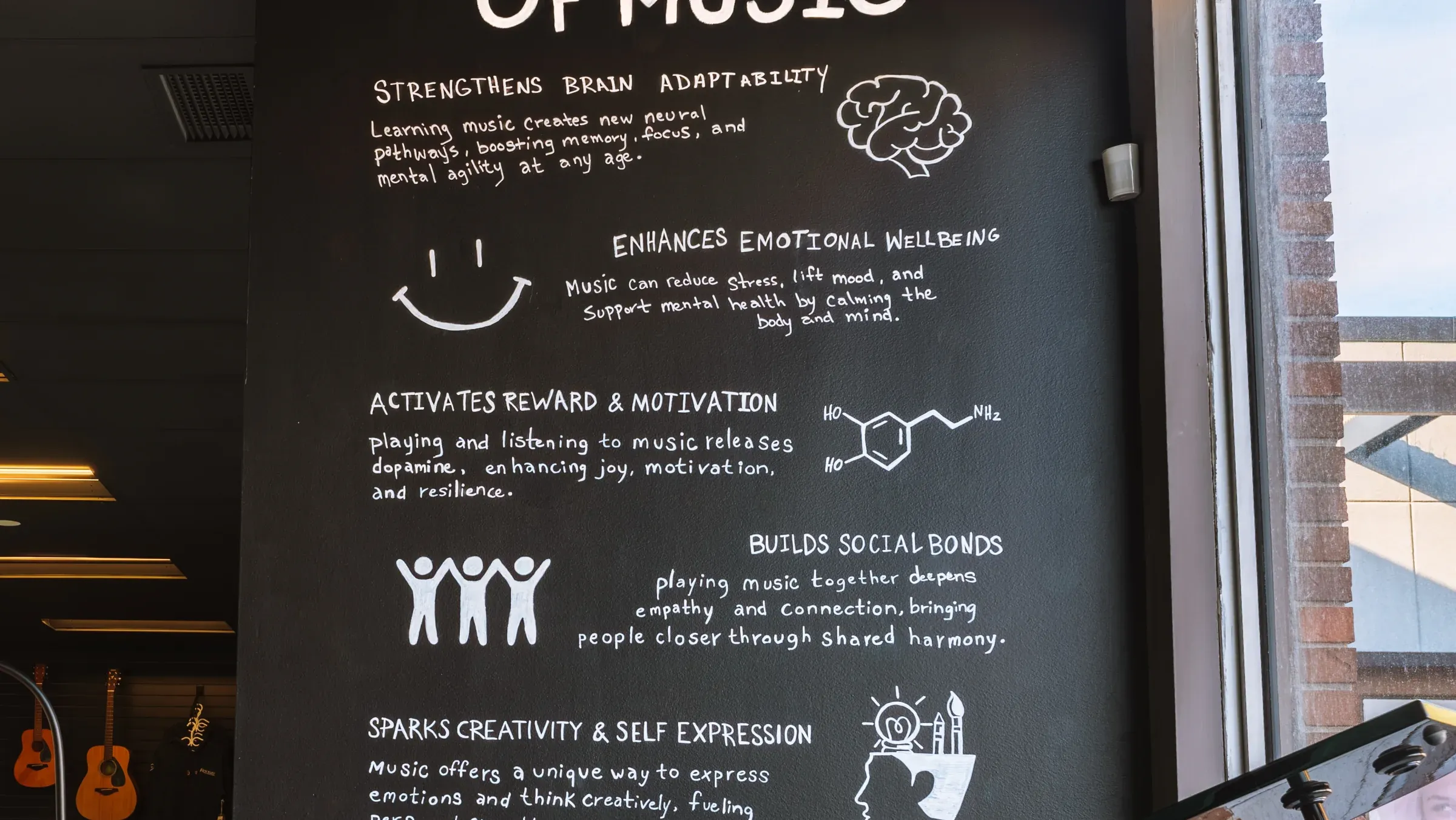
The publication takes its name from a wall at the school, where five claims about what music does are hand-painted in the lobby. The essays here treat each of those claims with the care the wall implies.
- Practice Notes
The case for singing badly
Most people who say they cannot sing are wrong about it, and singing does measurable things to the breath and the heart whether or not the notes land. A short look at what the research says about the voice nearly everyone already has.
- What Practice Builds
The bridge between the hands
Musicians who started before the age of seven carry a larger front section in the bridge between the brain's two hemispheres. The finding is real, and narrow, and often misread. It marks where one effect peaks, not whether music is worth starting at any age.
- The Listening Mind
The song you can still find when nothing else is left
A woman in the late stages of Alzheimer's could no longer name her own children. She could still sing every word of the hymns she learned as a girl. The neuroscience now has a partial answer for how that happens, and it is stranger than the usual story.
- The Early Years
Music is not enrichment. It is infrastructure.
Three labs, working independently, kept finding the same thing in early childhood: that music does load-bearing developmental work before a child can speak. Read together, their studies describe something closer to scaffolding than to a hobby.
- Music Across Cultures
A forest where everyone sings
In the forests of the Congo Basin, the Aka sing a four-part vocal polyphony as complex as anything written down in Europe. There are no professional musicians and no audience. The complexity is what participation produces.
- Music in Hard Places
The man who returned for three minutes
An 89-year-old in a nursing home, almost entirely silent for years, sat up and sang along when someone placed headphones playing Cab Calloway over his ears. Sixty million people watched the clip. The story behind it deserves to be told the way it actually happened.
- What Practice Builds
The OPERA hypothesis: why musicians hear speech differently
A neuroscientist named Aniruddh Patel proposed in 2011 that musical training rewires speech processing under five specific conditions. Each one is mundane on its own. Together they explain why a violinist can hear a conversation in a noisy room more clearly than a non-musician of the same age.
- The Listening Mind
What a chill down your back is doing
When music gives you goosebumps, your brain has just released dopamine in two distinct waves. The same neural circuits that fire for the body's most basic survival rewards fire for a violin entrance. The strangeness of this finding is worth sitting with.
- Practice Notes
What music to listen to while you work
A short, useful summary of what the research actually says about music and focus. Some of it lines up with intuition. Some of it does not. Lo-fi beats fans may want to look away.
- The Early Years
Why fourteen-month-olds help the people who bounce them in time
A McMaster researcher bounced infants in time with a stranger across the room. Minutes later, the babies who had been bounced in sync were more likely to help that stranger when they dropped something. The finding rearranges a small piece of what music does.